
Beyond The Frame
One image. Two lives. Twenty-three years of silence.

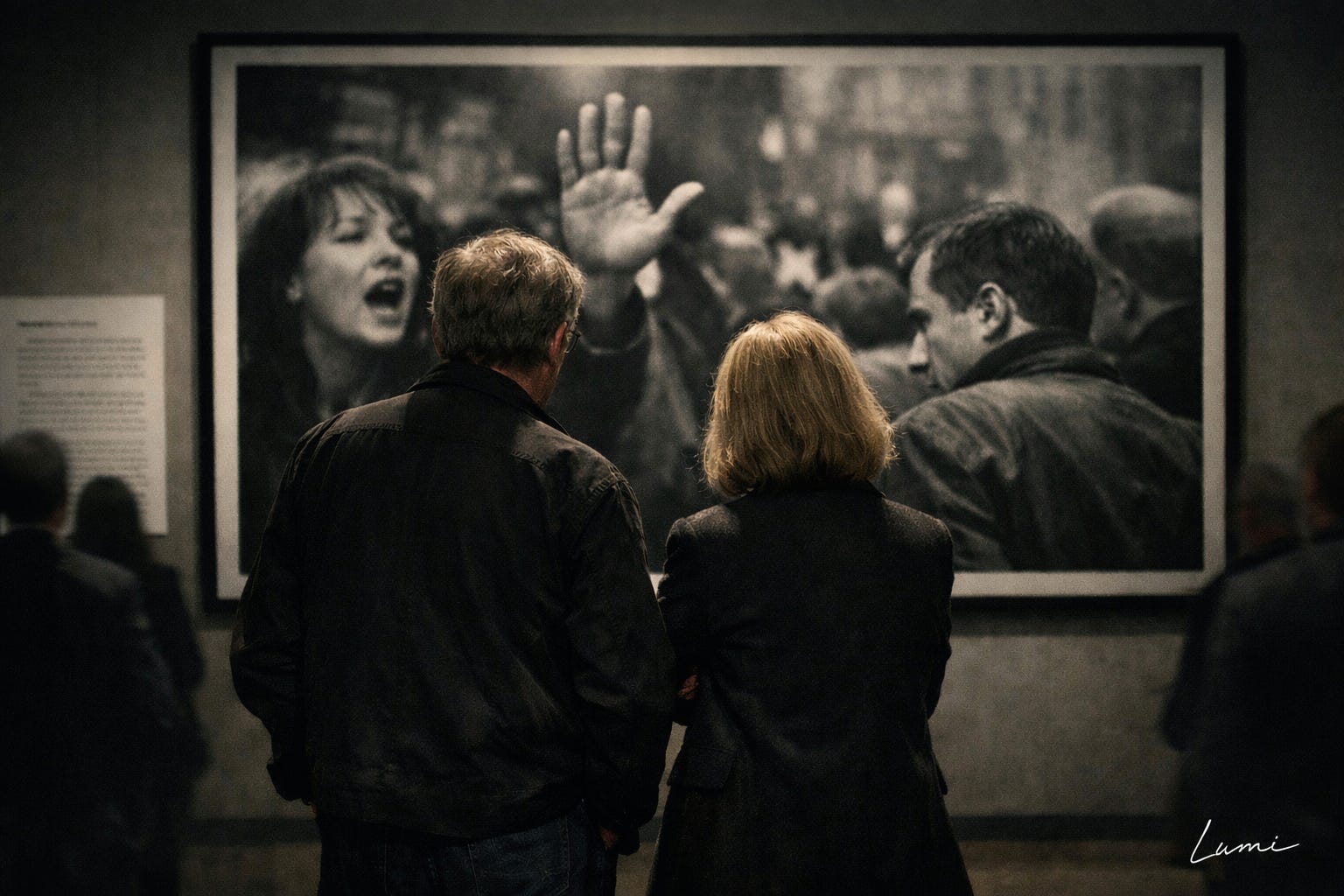
They meet beneath it.
The print is larger than either of them remembers the moment being. Monumental, almost theatrical. A crowd frozen mid-breath. A woman’s mouth half-open as if she is about to speak. A hand lifted, palm outward, a gesture that could be warning or something else entirely. In the lower right quadrant, just off centre, a man turns his face slightly away from the camera.
As though he feels it.
As though he doesn’t want to be caught inside it.
He is older now, of course. The man in the room; not the one in the frame. Greyer. Softer in the middle. But the line of the jaw is still there. The habit of standing with his weight on one leg, as if he might need to leave quickly, even when there is nowhere to go.
“You came,” he says, not quite surprised.
She stands beside him, arms folded loosely, the way people do when they’re not sure what to do with their hands in places like this.
“I was invited,” she says. “You weren’t?”
He gives a small, thin smile. “They like a full circle.”
They have not spoken in twenty-three years. Not since the morning after, when the streets were still cordoned off and the radio kept repeating itself: regrettable incident, necessary measures, order restored. Not since she left with her cameras packed and her notebooks already trying to make sense of something that hadn’t settled yet.
Around them, the gallery hums. Wine glasses. Low voices. Shoes on polished floor. People drifting from image to image as if the walls are offering answers, or at least versions of them.
A placard explains the photograph in careful, neutral language. Dates. Numbers. Context arranged so it doesn’t spill too far in any direction.
She reads it anyway, though she knows the words.
“This photograph,” it begins, “captured a pivotal moment—”
“Pivotal,” he says quietly.
She looks at him.
“It’s a clean word,” he adds. “It doesn’t say who it was clean for.”
She doesn’t answer that. A young couple nearby are debating whether he looks defiant or afraid. Their voices are low, careful, as if the photograph might hear them.
“I never thought of myself as pivotal,” he says after a while. “Incidental, maybe. Replaceable.”
“You were visible,” she says, almost without thinking. “That was enough.”
He turns his head slightly toward her.
“You pressed the shutter.”
It isn’t said like an accusation. More like something he has carried around and turned over enough times that it has lost its sharp edge.
She keeps her gaze on the photograph. This is the familiar circle, the one everyone expects: intent, authorship, responsibility. It has been spoken about in panels and interviews until the words feel slightly detached from their original weight.
“That isn’t the question,” she says.
“No,” he agrees. “It never was.”
Silence settles again, but not evenly. It comes in patches, interrupted by footsteps, a laugh somewhere near the entrance, the faint clink of glass being set down too firmly.
In the photograph, his younger self is a fraction of a second from being taken into something irreversible. Not just physically. Something social, something lasting.
In the weeks after, his employer would distance itself with careful phrasing. Friends would stop calling. Even people who believed him would begin to speak more cautiously around his name. The inquiry would clear him, formally. That word again. Formally.
Her own trajectory moved differently. The image travelled. It appeared in newspapers, then books, then classrooms. It became an example. Of witnessing. Of courage. Of the camera as evidence.
She never entirely knew what to do with that.
“Do you remember,” he asks, “what you said just before?”
She does, but it takes a moment for the memory to arrive properly.
Heat. Noise. Metal somewhere nearby. The sense of bodies moving as one thing and then breaking apart. Her hands already on the camera, already familiar with the weight of it.
“Don’t move,” she says. “I think I said, ‘don’t move.’”
He nods slowly. “I almost did.”
That line sits between them longer than the others.
“I didn’t know,” she says after a while. “Not then.”
“No one does,” he replies. “That’s the problem. Or maybe it isn’t.”
They step closer to the photograph without really deciding to.
Up close, the grain becomes visible. The slight softness at the edge where the light didn’t quite land right. The imperfections that later got called honesty, as if imperfection were a deliberate moral choice rather than a condition of the moment.
“I remember when they first enlarged it,” he says. “It felt wrong at that size. Like it belonged to someone else.”
She glances at him. “Because it was you?”
“Because it was too definite,” he says. “I didn’t feel that definite at the time.”
A pause.
“I thought they’d picked the wrong man.”
That makes her exhale something close to a laugh, though it doesn’t fully arrive as one.
Around them, people continue to circulate. A phone is raised, then lowered again without taking the picture. Someone reads the wall text twice, as if it might change.
“People think the photograph tells the truth,” he says eventually. “But it only tells that I was there.”
He looks at the younger version of himself.
“It doesn’t say what I’d already lost. Or what I was about to lose.”
She thinks of the questions she has answered over the years. Ethical questions that always sound cleaner in rooms like this than they do in the moment of taking the image.
“I used to say,” she begins, then stops.
He waits.
“I used to say that if something mattered enough to photograph, it mattered enough to show.”
“And now?”
She watches a couple move on to the next image, already forgetting this one as they leave it behind.
“And now I think showing changes things,” she says. “Not always in ways you can recognise while it’s happening.”
He nods, as if that lands somewhere familiar.
A silence follows that feels less like an absence and more like shared fatigue.
“They say this image changed things,” he says. “Do you believe that?”
She takes her time. “It changed conversations.”
A small pause.
“It changed careers.”
She gestures faintly between them.
“It changed us.”
“But did it stop anything?”
The question isn’t sharp. It’s just there.
She looks at the photograph again. The raised hand. The turning face. The moment that looks, in hindsight, like it knew it was being recorded.
“No,” she says.
That answer doesn’t seem to surprise him.
A group gathers briefly near them, then drifts away again. Someone half-listens, then decides not to.
“I don’t want it taken down,” he says after a while.
She looks at him. “The photograph?”
He nods. “I don’t want it erased. Or softened into something harmless.” A pause.
“I just don’t want people to think it ends here.”
She considers that.
“We could add something,” she says. “Your account. Your words.”
He almost smiles. “You’re still trying to fix it.”
“Maybe,” she says. And then, a little more quietly, “or maybe I don’t know how not to listen anymore.”
That lands differently between them. Not resolved. Just present.
The room begins to empty in small stages. The wine runs out. Chairs are gathered. A curator’s voice appears, gentle, indicating closing time as if it is a suggestion rather than a decision.
They stay a little longer than they need to.
When they finally turn away, she looks back once more at the photograph.
At his younger self.
At the crowd.
At the space just outside the frame where she once stood, not yet aware she would become part of the image in a different way.
For a moment she feels that distance more clearly than the image itself.
Then it fades again.
“Thank you for coming,” she says.
He nods. “Thank you for staying.”
Outside, the city continues as it always does. Cars passing. A bus braking too sharply. Someone laughing into a phone. Nothing acknowledging the photograph that remains behind them.
Inside, the image stays lit.
Still doing its work.
Not as an answer.
More like something that keeps asking without expecting certainty in return.

I’m so glad you’re here. Every reader helps keep this space alive. All subscribers receive the new writings from The Ethics of Tenderness—and if you choose a paid subscription, are helping this work continue, a gesture of shared care for what is tender, true, and beautiful.
If something here stirs you, feel free to share it with someone who might enjoy it too. I’d love to hear your thoughts, a line or two in the comments, or even just a quiet nod that the words reached you. Every little gesture helps this small space grow gently, and your presence matters.